by
Assoc. Prof. Dr. Mohamad Nizam Mohamed Shapie
Leader, Combat Sports & Martial Arts Research Network (AIRBORNE)
Faculty of Sports Science & Recreation,
Universiti Teknologi MARA (UiTM)
Research Paper Title:
Fitness Characteristics of Youth Silat Performers
Citation:
Shapie, M.N.M. (2014). Fitness Characteristics of Youth Silat Performers. Malaysian Journal of Sport Science and Recreation, 10(1), 40–53.
Purpose of the Study
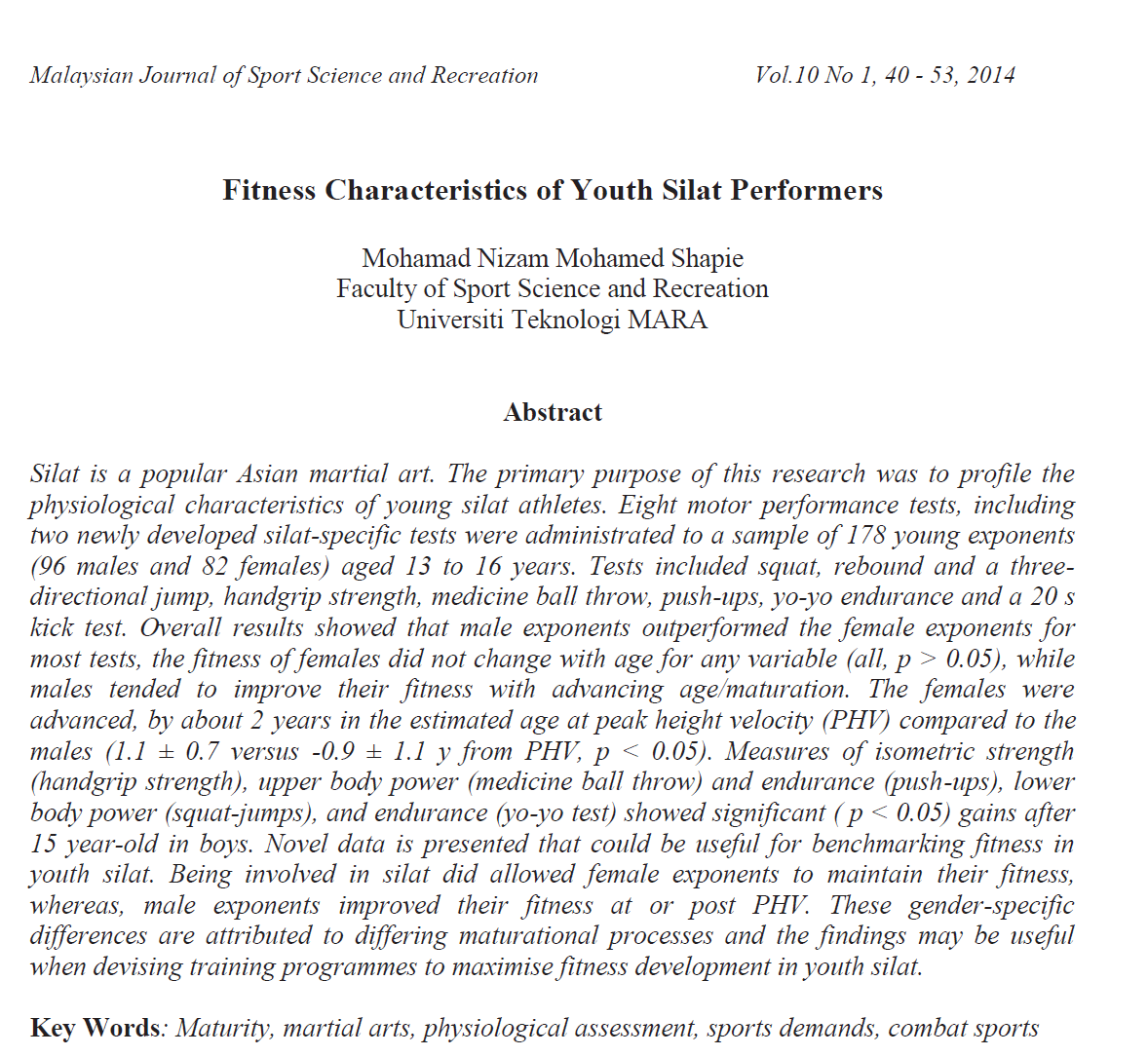
This study aimed to profile the physical and physiological characteristics of 178 youth Silat athletes (aged 13–16 years) in Malaysia, including 96 boys and 82 girls. It also tested the reliability of two Silat-specific performance tests: the 20-Kick Test and the 3-Directional Jump Test.
Key Findings
- Boys outperformed girls in most fitness tests including grip strength, push-ups, medicine ball throw, squat jump, and endurance.
- Girls showed no improvement with age, while boys improved significantly after age 15, coinciding with peak height velocity (PHV).
- 20-Kick Test and 3-Directional Jump Test were found to be reliable for assessing Silat-specific performance in youth.
- No age effect was found for Silat-specific tests, suggesting these abilities may be more related to coordination and neural development than physical maturity.
- Silat helped girls maintain fitness, even though they didn’t show performance gains with age.
- Training adaptations in boys were linked to hormonal changes during puberty, supporting the “trigger hypothesis” in youth athletic development.
Practical Implications
- Coaches should tailor training based on maturational stages, especially for boys around PHV.
- Girls may benefit from motivational and engagement strategies to maintain performance during adolescence.
- The 20-Kick Test and 3-Directional Jump Test can be used for talent identification, fitness benchmarking, and training evaluation in youth Silat programmes.
Tips for Application
For Fighters:
- Focus on developing strength, endurance, and kicking speed.
- Use Silat-specific tests to monitor progress.
- Understand your growth phase to optimize training.
For Coaches:
- Apply age-appropriate training based on PHV.
- Use Silat-specific tests for performance tracking.
- Encourage girls to stay active and engaged during adolescence.
For Parents:
- Support consistent training, especially during puberty.
- Understand that boys and girls develop differently.
- Encourage participation to maintain fitness and discipline.