by
Assoc. Prof. Dr. Mohamad Nizam Mohamed Shapie
Leader, Combat Sports & Martial Arts Research Network (AIRBORNE)
Faculty of Sports Science & Recreation,
Universiti Teknologi MARA (UiTM)
Research Paper Title:
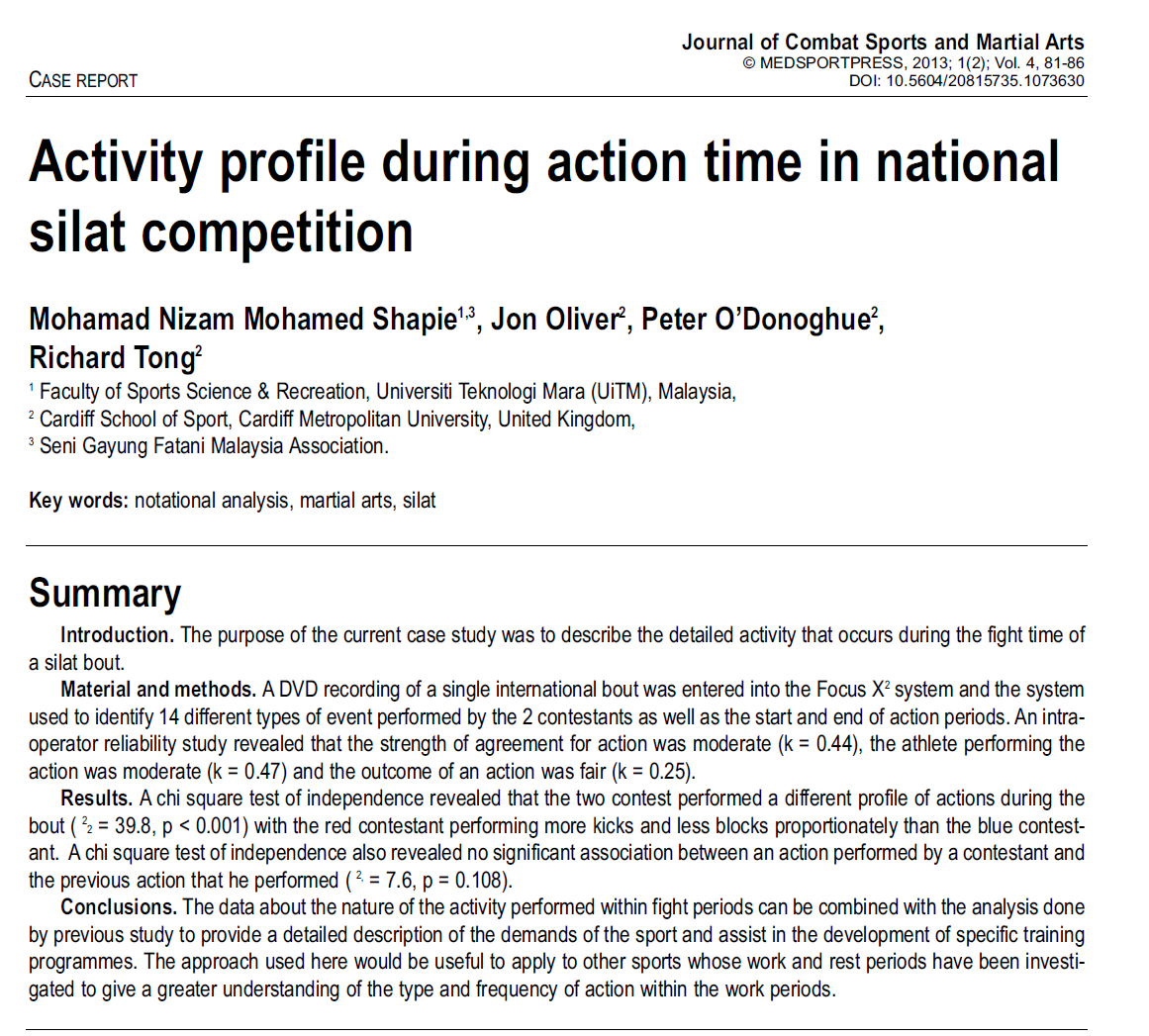
Activity Profile During Action Time in National Silat Competition
Citation:
Shapie, M.N.M., Oliver, J., O’Donoghue, P.G., & Tong, R. (2013). Activity profile during action time in national silat competition. Journal of Combat Sports and Martial Arts, 4(1), 81–86.
What Happens During a Silat Match?
This study analyzed a final match in the women’s 65–70kg category at a national Silat competition in Malaysia. Using advanced video analysis software, the researchers identified 14 types of movements performed by the athletes, including:
- Punches
- Kicks
- Blocks
- Catches
- Sweeps
- Topples
- Dodges
- Fake attacks
- Combination moves (e.g., block & kick)
- Low-intensity movements (e.g., posture and stepping)
Key Findings
- 57% of fight time consisted of punches and kicks.
- Punches were more accurate than kicks: 82.6% of punches hit the target vs. only 12.9% of kicks.
- The blue athlete, who won the match, used more kicks.
- The red athlete used more blocks and fewer kicks.
- 79.7% of actions were high-intensity, while the rest were low-intensity (e.g., posture or stepping).
Why This Matters for Training
The study shows that:
- Punching accuracy is crucial for scoring points.
- Kicking requires strong legs and can lead to fatigue if done repeatedly.
- Anaerobic energy powers high-intensity actions like punches and kicks.
- Aerobic energy helps recovery during low-intensity phases and short breaks.
Training should focus on:
- Improving punching technique and accuracy
- Building leg strength and endurance
- Practicing strategic movement and recovery
Practical Tips for Everyone
For Fighters:
- Train both upper and lower body strength.
- Focus on punch accuracy and kick speed.
- Learn when to block, dodge, or counter.
For Coaches:
- Use video analysis to study movement patterns.
- Plan training based on common match actions.
- Teach athletes to manage distance and timing.
For Parents:
- Support balanced training that builds strength and strategy.
- Understand that Silat is not just physical—it’s tactical.
- Encourage smart recovery and energy control.
Conclusion
This study reveals that Silat is a dynamic sport requiring smart training and strategic execution. By understanding the types of actions and their intensity, athletes and coaches can better prepare for real competition.
Stay tuned for more episodes in this series, where we continue to explore Silat through the lens of research and practical application!