by
Assoc. Prof. Dr. Mohamad Nizam Mohamed Shapie
Leader, Combat Sports & Martial Arts Research Network (AIRBORNE)
Faculty of Sports Science & Recreation,
Universiti Teknologi MARA (UiTM)
Research Paper Title:
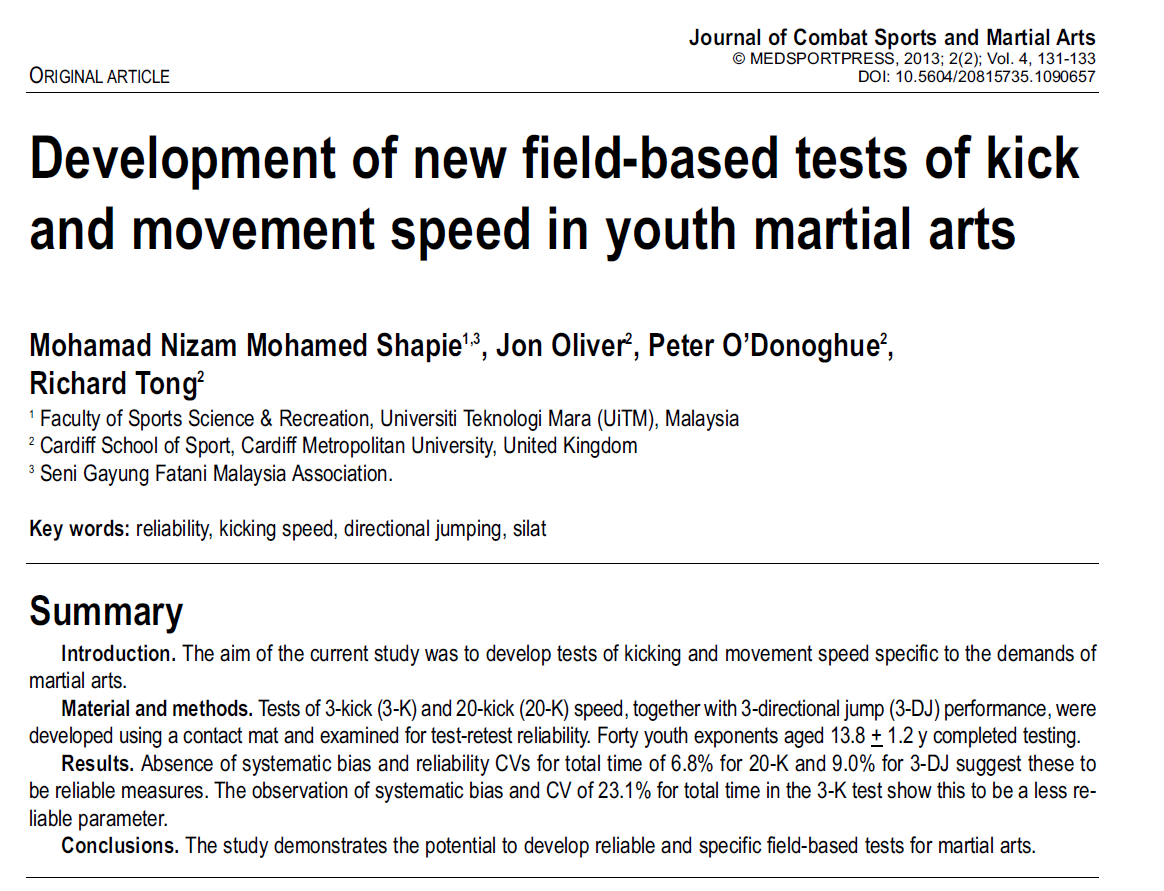
Development of New Field-Based Tests of Kick and Movement Speed in Youth Martial Arts
Citation:
Shapie, M.N.M., Oliver, J., O’Donoghue, P.G., & Tong, R. (2013). Development of new field-based tests of kick and movement speed in youth martial arts. Journal of Combat Sports and Martial Arts, 4(2), 131–133.
Why Was This Study Done?
Most martial arts fitness tests only measure general strength, speed, or endurance. But these don’t reflect the real movements and energy demands of martial arts like Silat. This study aimed to create specific tests that measure kick speed and movement agility, especially for young Silat athletes.
What Tests Were Developed?
Three new field-based tests were introduced:
- 3-Kick Test (3-K):
Measures the fastest time between three kicks.
🟡 Less reliable due to variation between trials. - 20-Kick Test (20-K):
Measures total time to complete 20 kicks.
✅ Reliable and reflects real match conditions. - 3-Directional Jump Test (3-DJ):
Measures agility by jumping forward, left, right, and back.
✅ Reliable and mimics evasive movements in Silat.
All tests used a contact mat to measure time and movement accurately.
Key Findings
- The 20-K and 3-DJ tests showed high reliability with low variation (CV < 10%).
- The 3-K test had more variation, suggesting athletes need more practice to perform consistently.
- These tests are better than traditional fitness tests (like sit-ups or cycling) because they reflect real Silat movements.
Why Is This Important for Training?
These tests help coaches and athletes to:
- Track progress in kick speed and agility
- Identify talented young fighters
- Design training that matches real match demands
- Evaluate the effectiveness of Silat-specific drills
Practical Tips for Everyone
For Fighters:
- Practice explosive kicks and quick footwork.
- Use agility drills that mimic real fight movements.
- Focus on speed and control, not just power.
For Coaches:
- Use these tests to monitor athlete development.
- Include directional jumping and repeated kicks in training.
- Help athletes improve consistency and reaction time.
For Parents:
- Understand that Silat training involves more than just fitness.
- Support training that builds speed, coordination, and agility.
- Encourage regular testing to track progress.
Conclusion
This study shows that smart testing leads to smart training. By using tests that reflect actual Silat movements, coaches and athletes can better prepare for competition and improve performance.
Stay tuned for the next episode in this series, where we continue to explore Silat through science and practical application!