by
Assoc. Prof. Dr. Mohamad Nizam Mohamed Shapie
Leader, Combat Sports & Martial Arts Research Network (AIRBORNE)
Faculty of Sports Science & Recreation, Universiti Teknologi MARA (UiTM)
Name of Research:
The Comparison of Balancing Between Male and Female Students at Faculty of Sports Science in Chulalongkorn University
Citations:
Razmi, R. R., Kusrin, J., Azidin, R. M. F. R., Shapie, M. N. M., & Boonrod, W. (2018). Malaysian Journal of Sport Science and Recreation, 12(1), 41–46. [2018 The C…le Student | PDF]
Purpose of the Study:
To investigate gender differences in balance performance during quiet one-leg standing among university students, using the Biodex Balance System SD.
Key Findings:
- Medial-Lateral Stability:
- Females had more normal scores (64.71%) than males (41.18%).
- Males had more “good” scores (58.82%) than females (29.41%).
- Anterior-Posterior & Overall Stability:
- Both genders had equal scores: 88.24% achieved “good” scores, and 11.76% scored “normal”.
- Conclusion:
- No significant gender difference in overall balance performance.
- Youth (both male and female) generally possess good balance capabilities.
Practical Implications for Silat:
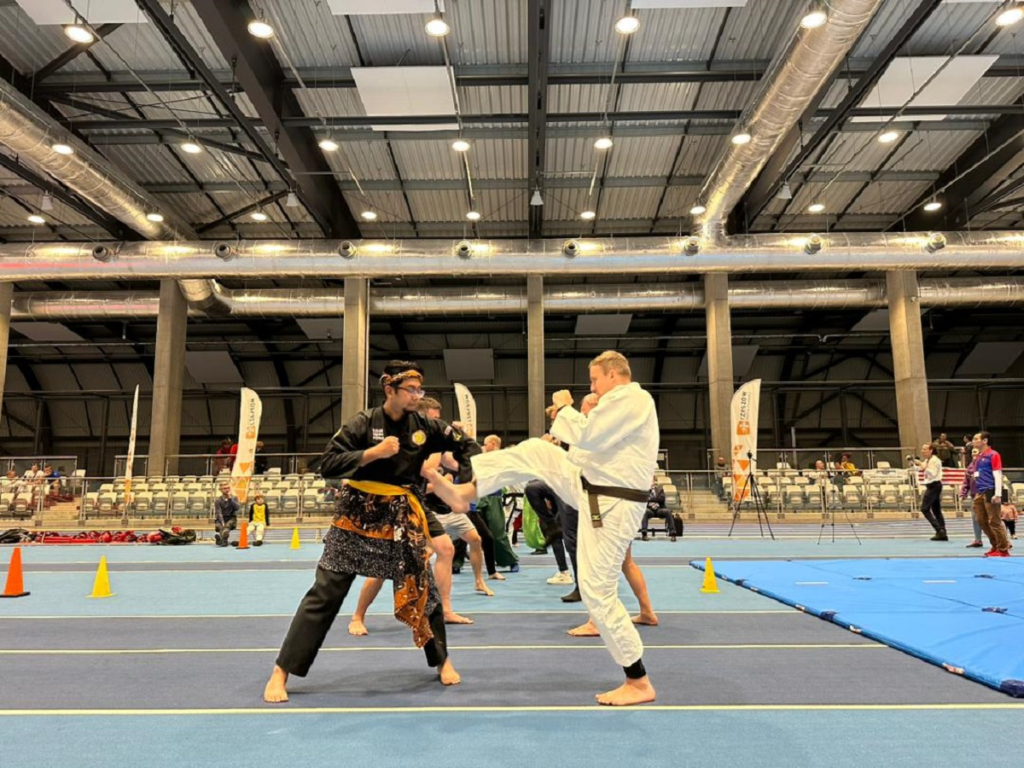
Although this study was conducted on university students and not Silat athletes, the findings offer valuable insights for Silat training, especially in Silat Olahraga, where balance is critical for executing techniques such as toppling, sweeping, dodging, and counter-attacks.
- Balance is foundational for Silat performance, particularly in executing high-intensity movements while maintaining control.
- Both male and female Silat athletes can achieve high balance performance, suggesting that training programmes should be equally rigorous for both genders.
- Medial-lateral and anterior-posterior stability are key components in Silat, especially during evasive maneuvers and recovery from attacks.
Tips for Application:
Athletes:
- Incorporate balance training tools such as balance boards, stability balls, and Biodex systems into regular training.
- Practice one-leg standing drills post-helicopter spins or dynamic movements to simulate match conditions.
Parents:
- Encourage young athletes to engage in balance-enhancing activities like gymnastics, yoga, or martial arts.
- Understand that balance is trainable and not inherently limited by gender.
Coaches:
- Use balance assessments to monitor athlete readiness and injury risk.
- Design gender-inclusive balance training programmes that challenge both male and female athletes equally.
- Integrate balance drills into warm-ups and cool-downs to improve postural control and reduce injury risk.