1. Introduction: The Hidden Power of Bunga Silat
In the world of Silat Melayu, bunga is often misunderstood. Many outside the tradition perceive it as ornamental, slow, or even irrelevant to actual combat. But to the trained eye and the awakened heart, the bunga is the soul of Silat—it encodes tactics, ethics, and philosophy. It is the starting point for all pesilat (Silat practitioners), acting as both a mental primer and physical blueprint. The bunga trains the body to become fluid, the eyes to become aware, and the heart to remain centered before the storm of battle. This article explores seven sacred movement elements within the bunga silat repertoire that symbolize Malay principles of war, balance, and respect—preserved and promoted through organizations like PASSMAL and documented by FSR UiTM researchers.
2. The Ritual of Readiness: Langkah, Kuda-kuda, and Limbai Tangan
The first sacred component in the bunga is the langkah (stepping). Every langkah in Silat Melayu is intentional—designed to cover ground strategically, control distance, and shift between offensive and defensive postures. These are not just physical steps but spatial geometry rooted in warfare.
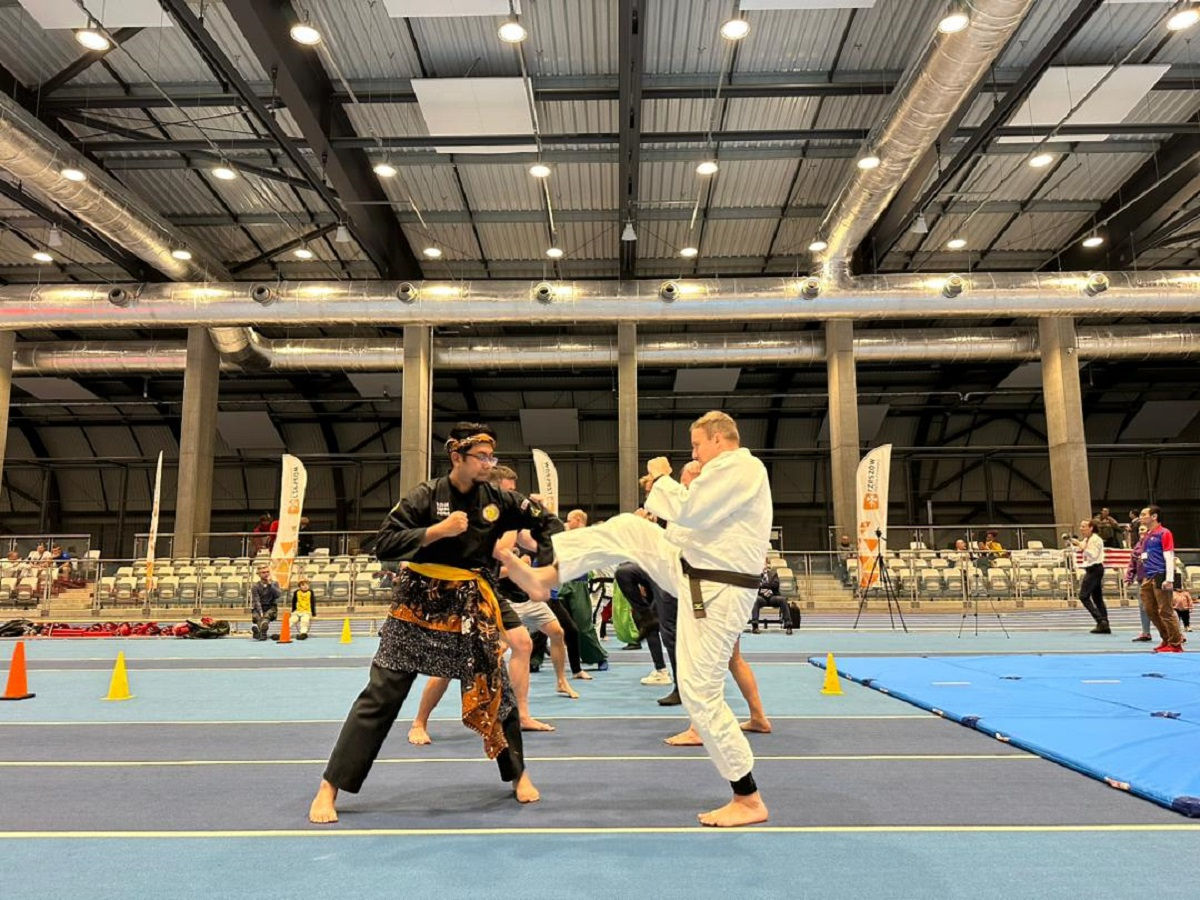
Complementing langkah is the kuda-kuda (stance), which symbolizes readiness, grounding, and strategic adaptability. In Silat Melayu, there are three main types of kuda-kuda—tinggi (high), sederhana (medium), and rendah (low)—each reflecting a distinct tactical and philosophical orientation:
- Kuda-kuda tinggi emphasizes agility and speed, often used in deceptive movement and feinting strategies.
- Kuda-kuda sederhana balances offence and defence, ideal for maintaining mobility while anchoring one’s position.
- Kuda-kuda rendah, on the other hand, offers maximum stability and strength, commonly used in grappling, close-range engagements, and defensive anchoring.
These stances are not merely biomechanical postures—they mirror the Malay philosophy of situational awareness and adaptability. Each kuda-kuda prepares the pesilat for different elevations, terrains, and emotional states in battle. Through proper training under certified gurus in PASSMAL and PESONA, these stances become more than forms; they evolve into a language of physical resilience and cultural identity.
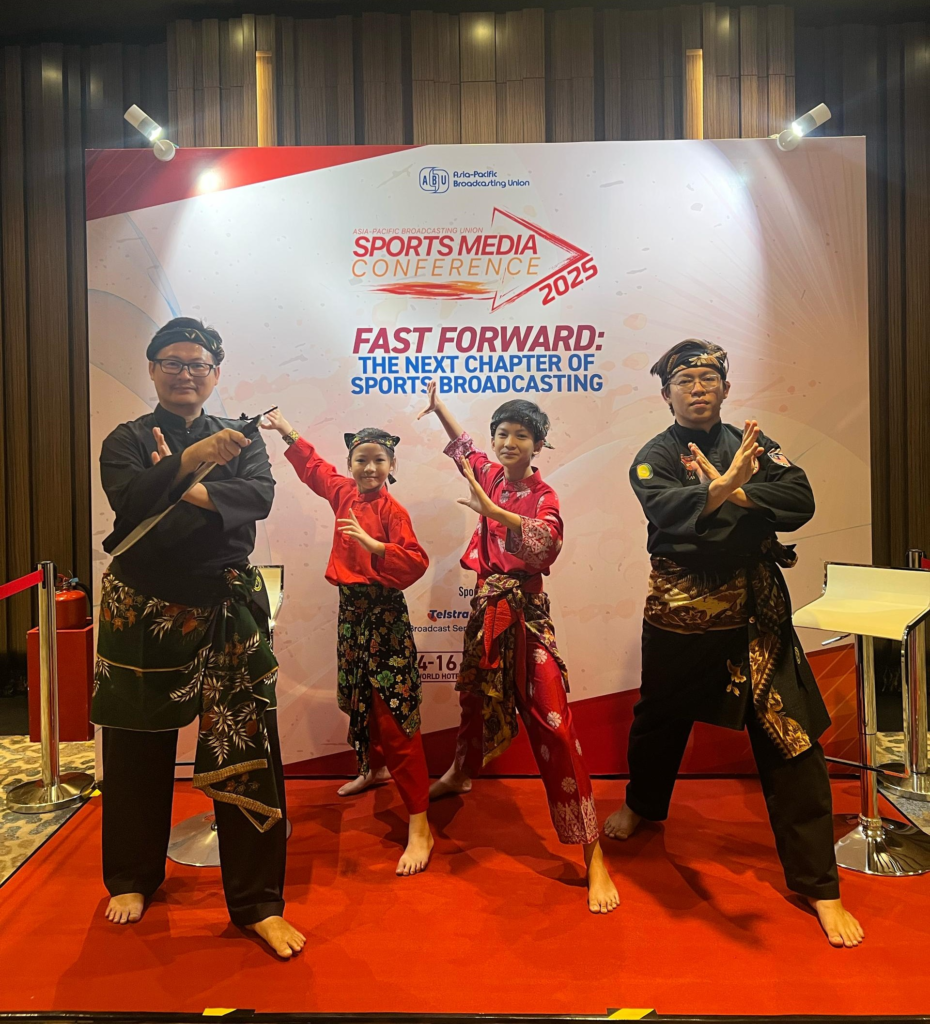
Accompanying these stances is the limbai tangan (flowing hand gesture), a defining feature of the bunga that bridges movement and meaning. Often graceful and circular, these gestures are deceptively subtle, designed to mask intent, redirect energy, and maintain rhythm. In traditional practice, limbai tangan signifies humility, alertness, and tactical readiness—evoking the principle of halus (refined subtlety) at the heart of Malay martial arts.
3. The Defensive Spiral: Elak, Serong, and Buah Pukulan
Three sacred motions revolve around deflection and redirection, embodying the Silat Melayu strategy of avoiding to defeat. The elak (evasion) teaches the pesilat to dodge and reposition without absorbing impact—evoking a strategy of fluid survival rather than brute confrontation.
Serong (angled movement) enhances this fluidity, allowing the practitioner to sidestep direct lines of attack and enter the opponent’s blind spots. Serong is about angles and psychology—it teaches control of space, timing, and perception.
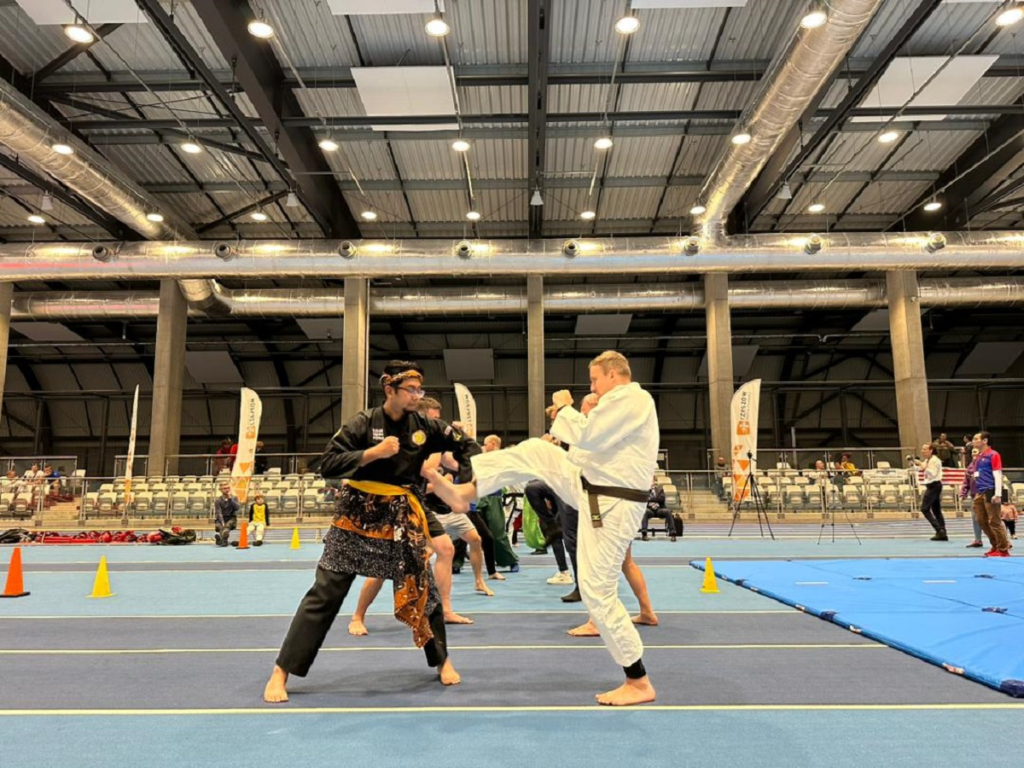
The buah pukulan (core striking techniques) marks the moment Silat transforms subtlety into force. These strikes—elbows, punches, knees—are compact and efficient, often concealed within the flow of bunga. They represent decisive application, trained to emerge when the moment is right, and the enemy is least prepared.
4. The Final Gesture: Simbolik Gerak (Belebat and Tapak)
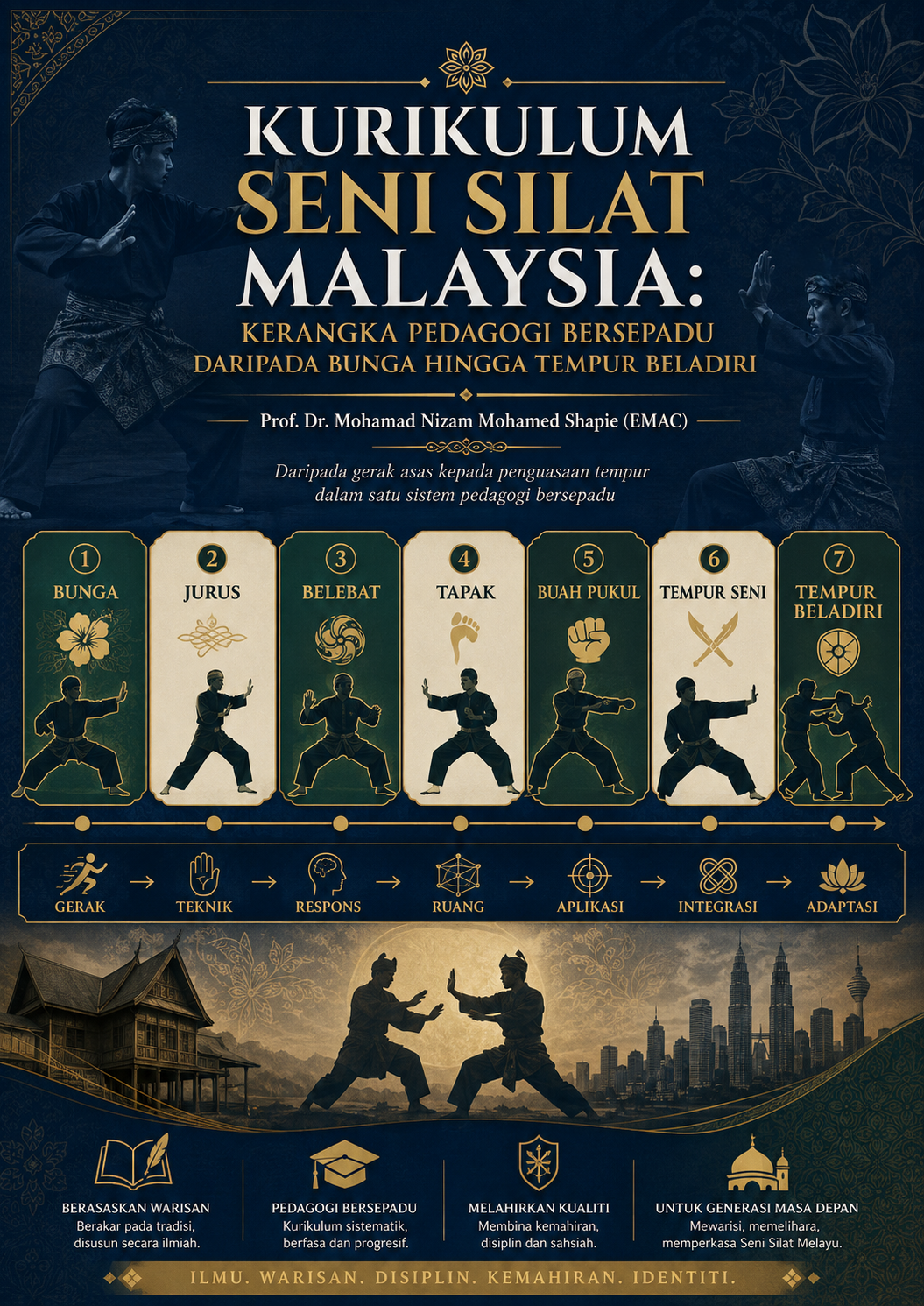
The seventh sacred motion is simbolik gerak—symbolic gestures and dramatic transitions that signify the intention to begin or end combat. Among the most widely preserved examples are belebat (a pre-combat flow sequence) and tapak (ground positioning drills), both of which are deeply embedded in the philosophy of Silat Melayu.
Belebat is performed as a flowing response to imagined attacks, integrating footwork, hand movement, and timing to prepare the pesilat mentally and physically. It reflects mastery of rhythm, awareness, and tactical entry. Tapak, on the other hand, is a systematic exercise in balance, structure, and control over territory. Through tapak, a pesilat learns to dominate ground space, maintain posture, and absorb or redirect pressure with minimal movement.
Together, these symbolic movements represent more than technique—they carry the spirit of preparedness, honour, and the internalization of ilmu (knowledge). Simbolik gerak ensures that combat in Silat Melayu is never random—it is ritualized, deliberate, and always guided by principle.
5. Preserving Sacred Movements Through PASSMAL and Research Innovation
With globalization and sportification eroding many traditional forms, the bunga silat faces a crisis of authenticity. PASSMAL plays a pivotal role in preserving these sacred forms through standardized assessments, instructor certification, and curricular safeguarding. Each of the seven movement concepts explored above is codified in PASSMAL’s curriculum for Silat Melayu Tahap 1 and 2, and now forms part of Malaysia’s national Silat pedagogy—without diluting the tradition’s soul.
UiTM, through the AIRBORNE Research Interest Group, has also undertaken performance mapping and motion analysis of the bunga to ensure its scientific relevance and historical preservation. Prof. Dr. Mohamad Nizam Mohamed Shapie continues to lead national efforts in fusing traditional Malay philosophy with contemporary martial arts education.
Conclusion: The Bunga as a Philosophy of Peace, Preparedness, and Power
To understand Silat Melayu, one must first understand its bunga. This is not choreography for show, but code for survival. Within each motion lies a warrior’s prayer, a strategist’s wisdom, and a cultural blueprint for honourable combat. By studying the seven sacred elements of the bunga, today’s pesilat reconnect not only with their bodies but also with their ancestors, philosophy, and homeland. The preservation efforts by PASSMAL and the academic contributions of FSR UiTM ensure that the bunga remains not just a dance—but a declaration of identity and resilience in a rapidly changing world.
📚 References (APA 7th Edition)
- Shapie, M.N.M., Elias, M.S., Anuar, A. (2016). Silat: The Heritage of Malaysia (Silat: Warisan Bangsa Malaysia). The National Department for Culture and Arts, Ministry of Tourism and Culture.
- Shapie, M.N.M. (2020). Sports Science in SILAT: Application of Sports Science in Silat Training and Performance. Pertubuhan Seni Gayung Fatani Malaysia.
- Samsudin, H., Shapie, M.N.M. (2021). Silat Tempur vs Silat Olahraga: Which Is the Best Combat Sport for Children? In 10th IMACSSS Conference Proceedings.
- Shapie, M.N.M. (2021). The Warrior Attitude (Sikap Pendekar) in Malay Silat Encouraging Malaysian Interest in Global Martial Arts and Combat Sports. UNESCO ICM.
- Shapie, M.N.M., Lee, K., Rahim, M.R.M., et al. (2022). Anuar Abdul Wahab (1945–2009): The Leadership and Contributions To The Establishment Of Traditional Art of War Into Modern Malay Silat. IMACSSS Proceedings.
- Parnabas, V.A., Abdullah, N.M., Shapie, M.N.M., et al. (2023). E-learning Motivation Among Student-athletes of Universiti Teknologi MARA (UiTM), Malaysia. Malaysian Journal of Sport Science and Recreation, 17(1), 20–34.
- Shapie, M.N.M., Nur, A.A.J., Kusrin, J., Wahidah, T., Elias, M.S. (2018). Activity Profile between Winners and Losers in International Silat Olahraga Matches. Journal of Physical Fitness, Medicine & Treatment in Sports, 2(4).